Posted on Leave a comment

The Beating Heart of Pottery in South Cotabato

South Cotabato Pottery
Pottery in South Cotabato

The Beating Heart of Pottery in South Cotabato

When was the last time you thought about commitment? Was it yesterday? Or when you had to sign the university enrollment form a year ago? Maybe when you felt good about making your first ceramic piece last weekend? Then, you started to think about pursuing a more comprehensive and lengthy ceramic training program. 

For Agustin Cabance, a potter from Brgy. San Felipe, Tantangan, South Cotabato, commitment is not just an idea but a daily part of his life for many decades. 

Kon ikaw isa ka-potter, katunga gid na sing kabuhi mo ang pag-pottery¹,” Cabance warmly shared these words as I sat in front of a pile of terracotta pots he made while Oda, enamored by the tranquility of the province, took a quiet nap in a duyan nearby. What Cabance wanted to highlight was the deep dedication it takes to become a potter and being a potter means half of your life is committed to the art of pottery-making.

Cabance came from a family of potters. The Juanillos, relatives of Cabance’s grandparents, were originally from Iloilo but they moved to Tantangan, which was still part of Buluan, Maguindanao del Sur back then, in the 1970s. They have been practicing pottery-making since they were living in Iloilo but they did not know how to cultivate land for farming, and so they had to continue their pottery practice in Tantangan for a source of living. Among all the other areas in the province, they found the right spot where they can harvest a suitable clay for their pottery works along the grounds of Brgy. San Felipe in Tantangan, South Cotabato. Hence, the forefathers of Cabance decided to settle in San Felipe and invited his grandparents to migrate in the same barangay through a telegram. Together, as one of the earlier settlers of San Felipe, they sold terracotta planting pots, kolon or a cooking pot in Hiligaynon, banga (jars), and kalan (traditional cooking stove). But unlike today, they used a method they call “pikpik” which is closely similar to how the many generations of potters in Aklan and in Antique create a palayok — the usual traditional cooking pot in the Philippines.

South Cotabato Pottery

It was only when a man from the Dizon family of Pampanga brought a pottery wheel to San Felipe when Cabance’s relatives learned how to throw on a wheel. Cabance, the third generation potter of their family, was already seven years old at that time when they encountered their first pottery wheel. Dizon, who taught them how to throw, was the same person from Pampanga who also made visits to the potters of Digos, Davao del Sur. However, we cannot confirm if he also brought the first pottery wheel to the potters of Digos.

Pottery in South Cotabato

Nakita ko man abi halin sang nag-pottery ang mga ginikanan ko. Amo na indi ko gid ni pag-bayaan kay mabuhi ka gid basta pisan ka lang. Parehas sa amon, amo lang nang gakabuhi sa amon halin sang gamay. Ang mga kabataan ko amo man nang nakabuhi²,” Cabance reflected on the role of his ancestors in helping him understand the impact of pottery-making in their lives. He acknowledges that he had seen the value of pottery-making from his parents and its value has been passed on to the next generations. He affirms  that pottery-making may be an exhausting day-to-day experience, but every sacrifice will never be a waste.

South Cotabato Pottery

It may take a lot of strength and energy to commit to pottery-making but he has seen how it helped him and his family grow together, not only in monetary rewards but also in nurturing their connections with each other. Because of this notion, despite having another responsibility as the Punong Barangay of San Felipe, Tantangan, Cabance promises to pursue pottery-making in remembrance of his forefathers who worked hard for their successors’ harvest, in a strive for fostering a culturally appreciative youth, and in the name of his home – San Felipe, the heart of pottery in the province of South Cotabato.

South Cotabato Pottery

The pottery scene in Tantangan only started to slow down when the COVID-19 pandemic made its deadly visit. You either had lower sales or no sales at all. Since then, many people who were only doing pottery for the sole motivation of making money had to close their pottery stores. They did not lift a finger to fight for it.

Cabance swiftly points out that money should not be the only motivation and the ultimate drive for pottery-making; one must get to know the medium step-by-step and learn it with more depth in order to stay in a relationship with pottery. Trained potters with one hundred percent commitment to the discipline of ceramic-making allows them to generate new strategies and exhaust all possible ways to save the craft. He also mentioned that it is important to think about the matters of sustainability first. 

South Cotabato Pottery

As I exchanged a couple of laughs and glances of reverential respect at Sir Agustin Cabance, I was also reflecting on his words and realized that our relationship with clay stays longer if we think of it as if we are dating to marry and not only dating for the sake of free food on dates and receiving luxurious gifts on monthsary dinners. As I was lost in thought for a few seconds, I remembered I had to ask my last question since Oda and I had to leave for my mom’s adobo that awaits us at home. And so I asked him about his aspiration for the tradition of pottery-making in San Felipe, Tantangan. Cabance, a third generation potter carrying his hometown’s legacy and an advocate for cultural preservation, uttered these words with pure determination:

Tani hindi madula ini asta sa pinaka-last nga henerasyon. Damo nahimo ang pottery sa amon kinabuhi, tani hindi ni pagkalimtan bisan ano pa mangin propesyon sang mga kabataan. Hindi ko ni pagbayaan kay naumpisahan ko na  ining amo ni nga palangabuhian.” 

And his words may be understood as:

“I hope that this (pottery-making tradition) lasts up until the final generation. Pottery has done a lot for our lives and may the youth never forget about it no matter what professions they may have. I shall continue what I started and never forsake this way of life (pottery-making).”

South Cotabato Pottery
The following Hiligaynon phrases and sentences above may be understood as:
¹ If you are a potter, half of your life is spent on pottery-making.
² I witnessed my parents’ pottery journey. And that is the reason why I will never forsake pottery-making. I believe that you can make a living from pottery for as long as you have the perseverance. Look at us, pottery allowed us to live a good life since we were young. Even my children are free to live their lives because of the work I do in pottery-making.
Picture of Written By Lin Bajala
Written By Lin Bajala

Lin Bajala, raised in South Cotabato, is a poet with literary works in Filipino and Hiligaynon. Her poems metaphorically describe the pain of losing, longing, and hoping.

She is also the curator for the core programs of Odangputik Art Space which are mainly designed for the progress of Philippine contemporary ceramics. Her practice often integrates decentralized structures and interdisciplinary concepts.

She took Master in Business Management Major in Finance in Mindanao State University and she is currently studying Art Studies in the University of the Philippines Diliman.

Above all things, Lin would prefer to introduce herself as a crazy cat lady.
Other Stories

Posted on Leave a comment

Terracotta Is The Warmest Color: Zeelah Aquilizan’s Probe For Identity

Zeelah Aquilizan Queer Art Pottery
Zeelah Aquilizan Pottery

Terracotta Is The Warmest Color: Zeelah Aquilizan's Probe For Identity

The road to self-discovery can be long and exhausting, yet we are still drawn to explore who we truly are. Some turn to social media with declarations like “solo traveling in Hanoi” or “moving to a big city” to kickstart their soul-searching journey. For Zeelah Aquilizan, a ceramic artist based in Quezon City, it began in the quiet corners of her studio.

When I think of terracotta sculptures of women, I am always struck by the works of Ms. Julie Lluch — their heightened tactile details and dramatically intense forms. It is uncommon to see terracotta sculptures in contemporary ceramic exhibitions at galleries in the Philippines; more often, terracotta artifacts such as burial jars and traditional pots are displayed in museums. So when I first encountered Aquilizan’s terracotta pieces at the 2022 “Virtual Hugs” exhibit, I was surprised. Aquilizan’s works at that time reminded me of the emotional response I had upon seeing Ms. Lluch’s Doxology at the National Museum of the Philippines. Although these works differ significantly in aesthetic style, both rely on carefully manipulating forms and the positioning of the subject’s body to convey the pain and suffering of a woman.

Recently, I had the chance to chat with the artist Zeelah Aquilizan, gaining a deeper understanding of how she shifted her medium from porcelain to terracotta, as well as the stories that shaped her sculptural subjects, all from the artist’s perspective.

Aquilizan started her pottery practice in her early 20s, now at her 29th year of existence.

4th-year college elective ako nakapag-pottery. Doon ako mas na-enganyo mag-ceramics… At nagustuhan ko rin kasi iyong metaphor – the process from something na malambot tapos may ibang elements, like water and air. Tapos ‘yong metaphor na high temperature, dadaan ka muna roon bago titigas ang clay, magiging mas durable siya. Pinakagusto ko kasi talaga ay hindi lang ‘yong ending niya (pottery-making) eh, iyong process talaga, iyong journey to get there. Kaya mas na-inlove talaga ako sa medium na ceramics”, Aquilizan describes the most beautiful aspect of the slow process of transforming soft, wet clay into a hardened material through kiln firing, as though it were a living poem from John Keats’ journal—a poem about how she developed a deep emotional connection with ceramics as an artistic medium.

Her process of creating ceramic sculptures helped her overcome insecurities and led her to self-acceptance. From feeling lost to finding herself. From absorbing the realities of other women to embracing her own womanhood as a Filipino queer woman. These are the changes Aquilizan underwent as she evolved her concepts over time.

Iyong konsepto ko kasi parang nag-start siya more on sa general experiences of women. Sa akin kasi feeling ko ‘yon pa ‘yong time na medyo hindi ko pa mahanap ang sarili ko. Parang tinatago ko pa ang sarili ko, parang tinatago ko siya through kuwento ng ibang tao. Iyong sarili ko talagang experience, hindi ko pa siya nakakayang i-express. Hanggang noong habang ginagawa ko siya, mas nakaka-relate na rin pala ako  (sa mga kuwento ng iba) at doon ko na sinubukang ipasok ang personal experiences ko.”

Pottery


Aquilizan shares that subconsciously, her desire to express her sexuality is gradually showing through the pieces she creates with terracotta, “Gusto ko talagang i-express iyong sexuality ko tapos ‘di namamalayang lumalabas na pala siya sa mga works ko. Iyong mga individual women na may mask, parang nandoon ‘yong want ko to expose myself pero ‘yong face ay nakatago pa rin hanggang sa nag-grow na ‘yong figures into intimate relationships, a search for community, and creating an environment na gusto kong mangyari in the future – isang safe space na pwedeng maibahagi sa ibang tao.”  

The artist draws a parallel between the arduous and painstaking process of transforming clay into ceramics and the equally challenging journey of self-discovery:

Noong nag-start ako (with ceramic-making) ito rin ‘yong time na lost pa ako. In finding yourself, parang feeling mo ang bigat ng pinagdadaanan mo para maging buo ka. So, parang doon ko na-relate iyong ‘figuring out my idenity’ para maging buo. Personal journey ko siya, habang nagbabago ‘yong buhay ko, binabago ko rin ‘yong concept ng mga works ko. At habang binubuo ko ‘yong mga nagbabagong konsepto, parang binubuo ko na rin ‘yong sarili ko.” 


The process of concept-making is not the only force that pushed for the artist’s personal and artistic metamorphosis; the switch from porcelain to terracotta also personified another visual manifestation of the significant changes she underwent. 

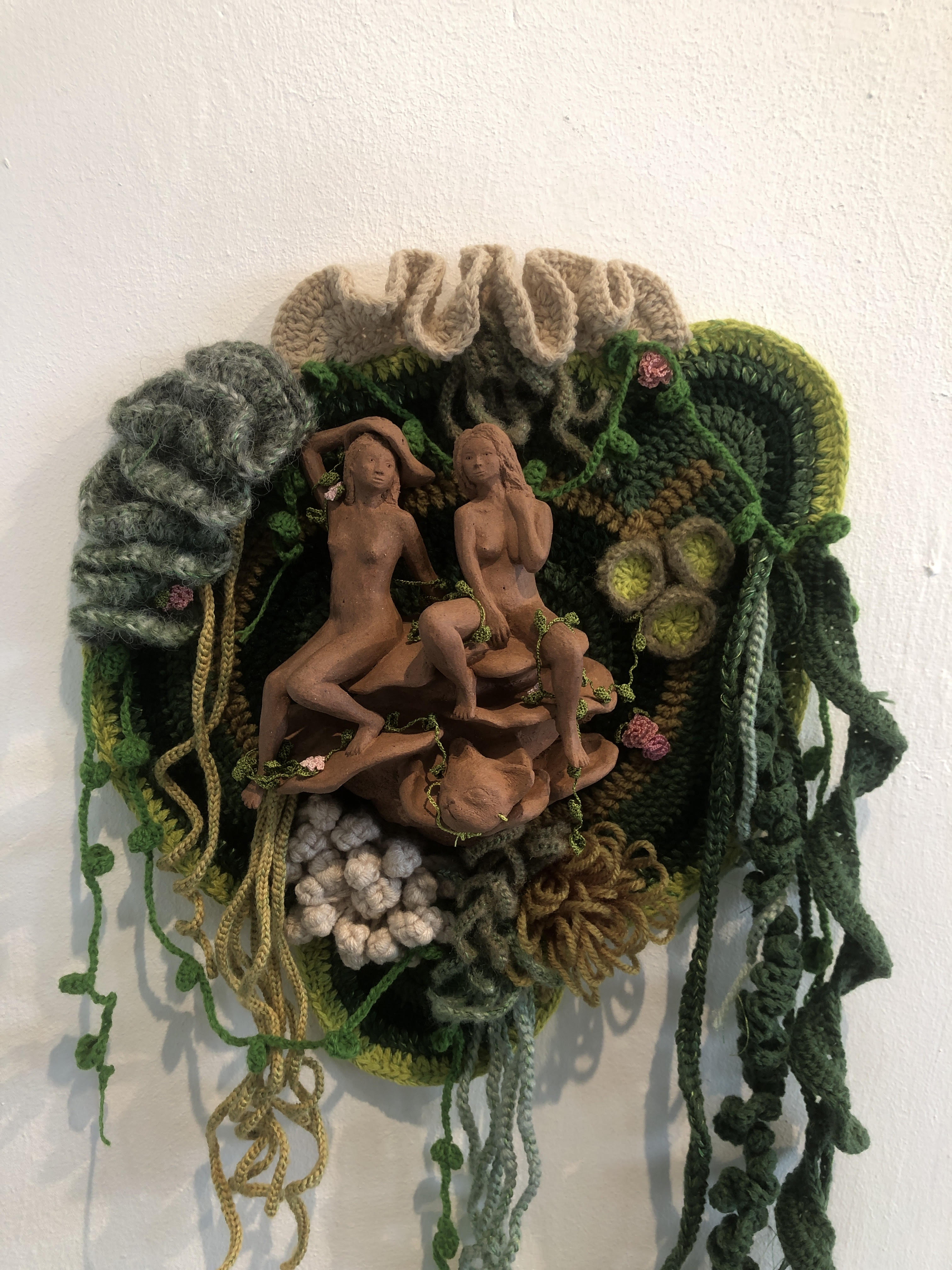
In 2017, Aquilizan was still using porcelain to create anthropomorphic sculptures, merging it with crochet—an unconventional material with contrasting qualities to ceramics (crochet is soft while ceramics are hard materials). Since galleries often use white walls and white pedestals, Aquilizan conceived the idea of combining crochet with porcelain to create a backdrop for her white, glassy porcelain sculptures, creating emphasis on the porcelain figure as the focal point. Until she transitioned to terracotta, crochet pieces were present throughout the composition, serving as parts of the background, foreground, and middle ground. 

Porcelain

Growing up, the artist internalized the belief from her circle that being maputi or light-skinned was considered beautiful, leading her to despise her brown skin from an early age.

In her 2020 series, “Hello 
Ate, Kumusta?”, Aquilizan reached the point of embracing her morena skin as she exhibited her first terracotta sculptures. No longer hiding beneath a glossy facade; here comes the naked truth and the courage to expose vulnerability from the raw emotions of a woman. 

Aquilizan’s transition to unglazed terracotta from glazed porcelain is like choosing to unwrap her true self and nurture self-love through the context of materiality. But a more heartbreaking analogy for this material change is also grounded in the observation that terracotta is often an overlooked medium in the arts scene, particularly in the fine arts. Many regard it as irrelevant cheap material, fit only for making pots that are easily discarded. These perceptions parallel how society views women as the epitome of the Maria Clara archetype, expecting them to be devoid of carnal desires. Women’s sexuality is excluded as a thing of importance in a patriarchal society. This very notion is visually challenged by the use of terracotta clay itself, a material that brings this resistance to life, along with the three-dimensional portraiture of two women sharing genuine intimacy.

 
Pottery

Looking forward to the future, Aquilizan eagerly dreams for her fellow queer women, who are unable to find a community, to feel a sense of belongingness like the way she found her home in terracotta: 

Sa Cagayan Valley kasi galing ‘yong dad ko. Doon ko na hinugot ‘yong thought na (kumuha ng materyal) kung saan man ako galing.” 

She also adds that terracotta feels like home because it traces back to our ancestors’ pottery-making traditions during the pre-colonial period. The artist further hopes that her ceramic sculptures will bring comfort to women, especially queer women, who feel as though they have been fighting alone. She then recalls the terracotta sculptures she created of woman-like figures with whimsical masks covering their faces:  

The loneliness of parang mag-isa ka lang na pinagdadaanan ito, naka-mask pa kasi ashamed ka pa of who you truly are.” 

 
Pottery

This November 10, 2024, we can dive further into Zeelah Aquilizan’s ephemeral world of ceramics in her first solo exhibition under the Tuklas Art Residency Program at Eskinita Art Farm, Tanauan, Batangas. 

Picture of Written By Lin Bajala
Written By Lin Bajala

Lin Bajala, raised in South Cotabato, is a poet with literary works in Filipino and Hiligaynon. Her poems metaphorically describe the pain of losing, longing, and hoping.

She is also the curator for the core programs of Odangputik Art Space which are mainly designed for the progress of Philippine contemporary ceramics. Her practice often integrates decentralized structures and interdisciplinary concepts.

She took Master in Business Management Major in Finance in Mindanao State University and she is currently studying Art Studies in the University of the Philippines Diliman.

Above all things, Lin would prefer to introduce herself as a crazy cat lady.

Other Stories

Posted on Leave a comment

Looking back: A Compilation of Ianna Engaño’s Works for Xavier Art Festival 2022

Ceramic Art

Engaño’s works as part of the three-woman show, Caution Handle With Care, for the Xavier Art Festival 2022 under Eskinita Art Farm

Title: Self-portrait | Medium: Stoneware | Size: 8 x 9 x 11 inches


Self-portrait | Artist Statement: Mirrors and cameras show our reflections and images whilst this ceramic piece reflects the artist’s past. With a life filled with nothing but scarcity, Ianna used to be sickly and severely malnourished as a student while working multiple part-time jobs to secure necessities. The love for herself was frequently neglected and unrequited.
Although some parts of the past may not be buried in soil, the past can still be molded into a piece of timeless stoneware. Then, it will only stay as a memory, an inspiration to thrive and change for the better, but it will never drag down whatever is celebrated in the present time. For today, Ianna promises a wealth of love and reverence for herself.


Title: Bahay-uod | Medium: Stoneware | Size: 16 x 9 x 5 inches


Bahay-uod | Artist Statement: Fragile body but muscles are stiff. The mind seems to be a blank slate but it’s filled with lessons. Young but carries the responsibilities of an adult. This happens to a human being who was exposed to forced labor at an early age – carrying the weight of the whole family. She is like a caterpillar that needs to crawl to survive until it builds, on its own, the walls that will protect it from harm. Fast forward to the future, that cocoon will give birth to a new being where it won’t have to crawl for the rest of its life; it will fly high and spread abundant pollens of kindness and wisdom into barren land.

Title: Bao sa Kawalan | Medium: Stoneware | Size: 16 x 10 x 5 inches


Bao sa Kawalan | Artist Statement: The ocean, likened to nothingness and the unknown, can be a trap for creatures dwelling in it. When a small object is thrown into the ocean, ripples multiply and go the distance until the object damages a sea dweller’s body, causing it to die.
But we can still be in control of the ripple effect in the vast ocean that we call life. We may not alter the direction of the ripples but we can still do something to stop its continuum; we can only change what we can change in this life where not all things are pre-determined.


Title: Kaliskis Ko’y ‘Di Nakakahawa | Medium: Stoneware | Size: 19 x 11 x 4 inches


Kaliskis Ko’y ‘Di Nakakahawa | Artist Statement: A basket filled with five fresh apples and one rotten apple will make the rest of the apples rot. A grandmother told someone’s mother, a father said this to a teacher, a sister said this to a brother, and they all believed in it. And when the sanctimonious people said that a homosexual is a decayed apple in a basket filled with good apples, they believed.
Nevertheless, this artwork still believes that homosexuality is not a disease – it is not contagious nor ought to be medicated. It can only be accepted with all of your heart once perspective changes. Look at the endless rainbow, this is how gender is seen as a wide and beautiful spectrum.


All photos on this page were captured by Michael Angelo Sison

Picture of Written by Lin Bajala
Written by Lin Bajala

Lin Bajala, raised in South Cotabato, is a poet with literary works in Filipino and Hiligaynon. Her poems metaphorically describe the pain of losing, longing, and hoping.

She is also the curator for the core programs of Odangputik Art Space which are mainly designed for the progress of Philippine contemporary ceramics. Her practice often integrates decentralized structures and interdisciplinary concepts.

She took Master in Business Management Major in Finance in Mindanao State University and she is currently studying Art Studies in the University of the Philippines Diliman.

Above all things, Lin would prefer to introduce herself as a crazy cat lady.

Other Stories

Posted on Leave a comment

Ianna Engaño’s Stories of Transformation (Part 1)

Ceramic Art
“Bahay-uod”
Size: 16x9x5 inches
Medium: Stoneware
Photo by: Michael Angelo Sison

We hear people say that while the children are still young, let them play. That wasn’t the case for Ianna Engaño. At an early age, when she was too small to even lift a bag of goods, she struggled to fend for herself. Just like a caterpillar, she crawled to survive; she built a hard cocoon to protect her younger self from the horrors of this world until she blossomed into this butterfly that she had always dreamed to be.

The path to becoming an artist and, most importantly, a good person was a bumpy road for Ianna. The emotional, physical, and mental pressure that she had since she was a child until she became a young adult took a toll on her well-being. Fortunately, Ianna recently changed the way she looked at all these bad experiences. She began to think that those trials offered lessons that she wouldn’t have realized if life didn’t throw a full basket of lemons at her. The acquired knowledge and the motivation to push beyond her potential were, at least, the good things that all those unimaginable hardships gave her.

Photo by: Michael Angelo Sison 
Photos by: Michael Angelo Sison 
Bahay-uod is currently at Eskinita Art Farm, Tanauan City, Batangas

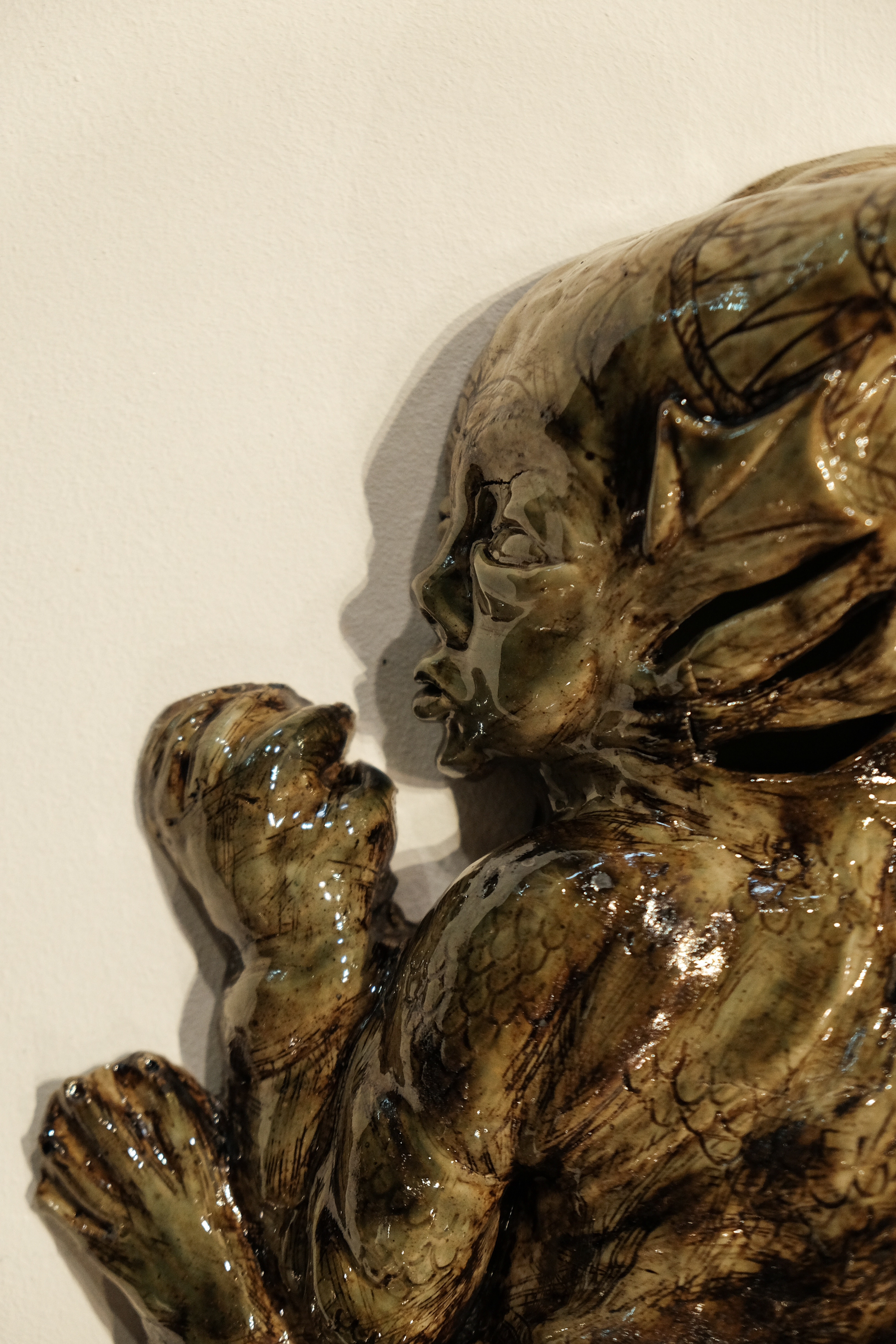
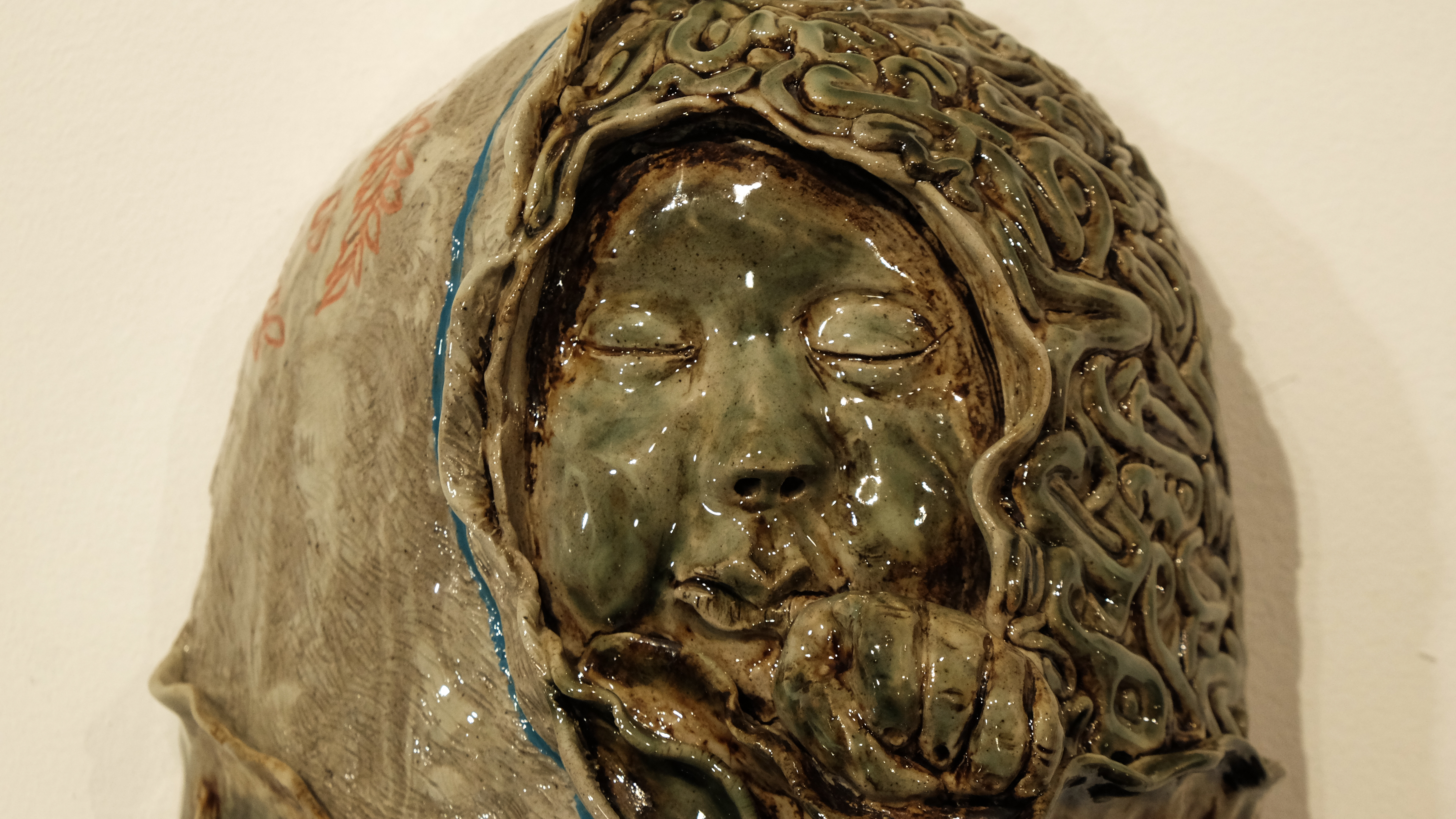
The artwork made out of stoneware clay tells one of Ianna’s stories of metamorphosis. The ceramic piece is a baby wrapped in a self-made cocoon that works as a shield against potential danger while lifting a closed fist, making her look like she is ready for a big battle – the survival of the fittest. On the right side of her head, a good morning towel can be seen. This is a cloth that most labor workers use to wipe off every drop of their sweat and this adds to the concept of child labor. On the left side of the baby’s head is an enormous brain with a message written in baybayin. If you can decode the baybayin letters on this ceramic sculpture, you will understand Ianna’s advice for the new and the older generations after she won over years of traumatic combat.

Picture of Written by Lin Bajala

Written by Lin Bajala

Lin Bajala, raised in South Cotabato, is a poet with literary works in Filipino and Hiligaynon. Her poems metaphorically describe the pain of losing, longing, and hoping.

She is also the curator for the core programs of Odangputik Art Space which are mainly designed for the progress of Philippine contemporary ceramics. Her practice often integrates decentralized structures and interdisciplinary concepts.

She took Master in Business Management Major in Finance in Mindanao State University and she is currently studying Art Studies in the University of the Philippines Diliman.

Above all things, Lin would prefer to introduce herself as a crazy cat lady.

Other Stories

Posted on Leave a comment

Meet the artist: Ianna Engaño

Ceramic Art

Ianna Engaño, born in Manila City and raised in the province of Cavite, is a ceramic artist with a Bachelor’s Degree in Visual Communication from the University of the Philippines in Diliman, Quezon City. This is the same university where she started to fall in love with clay when she became an apprentice at the UP College of Fine Arts Ceramic Studio in the year 2018.

Mixtures of social realism, environmental activism, and a personal storybook – these are the art pieces made out of stoneware and terracotta clay that Ianna Engaño shares in the local art community. She believes that art should be used to celebrate its beauty, reveal the truth, and side with virtue.

Ianna Engaño with her Tuklas mentor, Alfredo Esquillo, at Eskinita Art Farm, Batangas

Before she became a Tuklas 2021 awardee, she introduced functional ceramics as “Odangputik” on a social media platform last 2020 just when the pandemic hit us, and it was like a ray of hope back then. Now in the year 2022, for her brand, Odangputik, she’s working on artist collaborations to create rare ceramic collections for art enthusiasts and other functional ceramics for the greater public to love with the launching of her new website: odangputik.com. She recently created an open space for other people to learn ceramics which is now called Putik Studio. The ceramic artist will be seen more in upcoming gallery exhibits and shows in the Philippines.

You may check out Ianna’s background and other past events here:

  • Education and Certificate Programs

    • 2017 – Certificate Program in Visual Communication, University of the Philippines, Diliman, Quezon City
    • 2018 – Bachelor of Fine Arts in Visual Communication, University of the Philippines, Diliman, Quezon City
    • 2018 – Art Conservatory Level 1 and 2 under June Dalisay, Start 101 Gallery, University of the Philippines Campus, Diliman, Quezon City

  • Awards and Competitions

    • 2005 – Finalist, Internationational Competition, World Year of Physics, Art and Design Competition, Po Leung Kuk, Hong Kong
    • 2010 – Champion, Timpalak sa Gubat, University of the Philippines, Los Baños
    • 2011 – 1st place, Cavite wide Search for Math, Computer and Science Wizard On the Spot Poster Making Contest, De La Salle University, Dasmariñas, Cavite
    • 2012 – 9th place, Philobioscentia Poster Making Contest, University of the Philippines, Los Baños
    • 2012 – Finalist, Editorial Cartoon Filipino, Regional School Press Conference
    • 2012 – Finalist, Private School Press Conference, Department of Education
    • 2012 – Finalist, Division School Press Conference, Department of Education
    • 2012 – Best School Organization, Catholic Mass Media Awards, Cultural Center of the Philippines
    • 2015 – Finalist, Yamag Sining Yamag Dagat, Paperclay Art Competition, JNBM Paperclay
    • 2015 – 7th place, A Nationwide Editorial Cartooning Conference and Contest, San Bartolome High School, Novaliches
    • 2015 – 1st place, On the Spot Poster Making Contest, Philippine Department of Agriculture National Dairy Authority
    • 2015 – Featured Artist, Athlete, and Musician, Winners Against Asthma, GlaxoSmithKline (GSK)
    • 2016 – 2nd place, Gawad Pangulo On-your Spot Competition, University of the Philippines, Diliman, Quezon City
    • 2021 – Tuklas Awardee, Eskinita Art Farm, Tanauan, Batangas
    • 2021 – Grantee for Birth and A Hundred and Ten, National Commission for Culture And the Arts Bagong Biswal 2021

  • Workshops

    • 2021 – Speaker / Lecturer, PamanAgriArtKultura for 2021 National Heritage Month and Quincentennial Commemorations in the Philippines in Partnership with NCCA, JEFARCA, Province of Bulacan, and Municipality of Pulilan, Pulilan, Bulacan

  • Group Exhibitions
    • 2022 – Flight for Freedom, Lay of the Land, Eskinita Art Farm, Art Fair Philippines
    • 2022 – Haligi, The Light We Can’t Unsee, Vinyl on Vinyl Gallery, Makati City
    • 2021 – Sirenang Walang Laban, Alay 24, The Boston Gallery, Cubao
    • 2021- Shanties, Wunderkrammer, White Walls Gallery, Makati City
    • 2021 – Saan Aabot Ang Milyon Mo?, Nine Lives: Tuklas 2021 Winners, Eskinita Art Farm, Tanauan, Batangas

    • 2021 – Birth of A Hundred And Ten, J Studio, Makati City
    • 2021 – Out of the Blue, Tuklas 2021 Nominees, Tanauan, Batangas

  • Early Events (2015-2018)

    • Diskurso Thesis Exhibition, University of the Philippines College of Fine Arts, Diliman, Quezon City
    • Amorphic Group Exhibit, Start 101 Gallery, Diliman, Quezon City
    • Ceramic Sale, University of the Philippines’ Ceramic Studio, Diliman, Quezon City
    • Student Annual Exhibition, University of the Philippines’ Ceramic Studio, Diliman, Quezon City
    • Potheads: Art In the Park, Makati City
    • University of the Philippines College of Fine Arts: Gawad Pangulo Art Exhibition, University of the Philippines, Diliman

  • Affiliations

    • Mural Artist, PSMN Mural Group
    • Apprentice, Dolphins Love Freedom
    • Editorial Cartoonist, University of the Philippines Journalism Club
    • Apprentice, University of the Philippines College of Fine Arts Ceramic Studio
    • Apprentice, Ang Gerilya (Mural Group)
    • Apprentice, Artemis (Art Restoration Group)

  • Work Experience (Before Shifting to Full-time Artist)
    • 2015 – Artist, Gayuma, Quezon City Film Festival
    • 2015 – Contractor and Lead Artist, Props for UAAP Grand Opening, University of the Philippines, Diliman, Quezon City
    • 2016 – Apprentice, Simbuyo by Prof. Rita Gudiño, University of the Philippines, Diliman, Quezon City
    • 2017 – Apprentice, Idalmunon: Mebuyan Fountain by Prof. Rita Gudiño, University of the Philippines, Diliman, Quezon City

    • 2017 – Artist and Contractor, Horticultura Trophies, Quezon City Memorial Circle
    • 2018 – Artist and Founding Member, UP Muay Thai Medals and Logo, University of The Philippines, Diliman, Quezon City
    • 2018 – Ceramic Instructor, Introduction to Ceramic Workshop, Tahanan Pottery Shop, Timog, Quezon City
    • 2018 – Art Teacher, St. Alphonsus Liguori Integrated School
    • 2019 – Artist, Malamaya: The Color of Ash, Cinemalaya Film
    • 2020 to Present – Artist and Owner, Odangputik: Artworks by Ianna Engaño

Ianna, in her studio, crafting a new sculpture for an upcoming show

Posted on Leave a comment

The Pillar of This Home is Dying

Ceramic Art

Death and suffering are parts of our life cycle. It is easy to say this but when we come face to face with the end of life and agony, we become adamant in accepting that fate. The word “death” is not limited to the eternal stoppage of the human heart and the cells being discarded on the surface of our bodies; it can also be associated with the dying will of a person to live, the inability to find a reason to live, a moral principle that was buried, or even a promise that was forgotten. Suffering is also more than just a pain felt by a single person, it can be a decay that can rot a person’s spirit and suffering that can be passed on or shared from one person to another living being. Death and suffering are some of the most simple and common notions that we encounter in our daily lives yet they can still be as complex and intriguing as the first time you heard of the molecular structure of DNA.


Artwork Title: Haligi
Medium: Stoneware
Size: 21 x 10 x 4 inches


Ianna Engaño’s ceramic sculpture, Haligi, is a picture of death – the pillar of the home is dying. Yes, this may mirror the reality that there is a father in his last breath after years of working hard for his family but help came too late. He had been worn out for the rest of his life but distress and poverty still continue to suck him down to the grave that even if you send him aid, it does a little to help solve the problem. This is because of the environment that this father is currently in where everything is a quicksand; it does not allow us to rise from the cold harsh ground.

Haligi installation art is currently seen at Vinyl on Vinyl Gallery, Makati City, Metro Manila

However, if you look at this work of art from another angle, there’s more to it. The pillar of this home – this country – is dying. What will keep our country strong and what will make its foundation stand tall and everlasting? It is good governance which is deeply rooted in empathy, integrity, innovation, and the mission to serve that should be the pillar of this home. But where is it now? The quicksand is sucking it down to the grave and honestly, we still don’t know how are we going to save it. This is the truth that we cannot unsee or the light that we cannot unsee. Even though we do not have the answers right now, who says that we are going to stop searching for answers? Life is meant for an endless search.

Other Stories
Posted on Leave a comment

Mamamayan Ceramic Series Captures The Filipino People Amidst Crisis

Ceramic Art

"Nawala ang Sarili sa Loob ng Kwadrado" - photo taken in August 2021, Philippines

Years before March 11, 2020, I had only been counting sheep to get a good sleep at night. Nowadays, it’s different. It is the growing number of COVID-19 cases that I have been counting through day and night. I know that I am not the only one who has been anxious because of this pandemic. Many people are also affected by this crisis especially because of the slow actions taken to mitigate the problem in our country. Every day feels like a coaster ride for all of us – for an hour you’re excited, then in one snap, your spirit suddenly crashes down. Ianna Engaño’s new ceramic series, “Ang Mamamayan”, says all of these. It depicts the variety of emotions that we, the Filipino people, are experiencing in the middle of a pandemic.

"Lumalabo at Naglalaho" 
English Title: "Bleak Future Fades in the Dark"


The future seems bleak. We don’t have a clear picture of what would happen next. “Vaccines may work today but what if the time when it can no longer protect us finally happens?”, we hear this from the traumatized and the wary. Then, fear starts to set in as people start to realize how unpredictable times have been compared to what it was before. Whatever negative emotions that these people have right now is valid and they don’t have to apologize for the way they feel. We all deserve to acknowledge that our load is as significant as anyone else and it is not lighter than another friend’s plight. Nevertheless, we, at Odangputik, still hope that human beings won’t let fear and skepticism eat them up completely. Yes, the future is bleak but hasn’t it always been like that? Since the birth of Neanderthals, nobody can accurately predict what life on Earth looks like a decade from now.


Our health workers have been doing their best to provide us effective vaccines and intensive care. During this crisis, we only see half of their sacrifices. They’ve spent years in studying and preparing for humanity to be saved.


We are all tired. But keep in mind that this ceramic series will remind us of the battles that we survived. Someday, we’d still be holding into this ceramic piece while saying, “I’ve made it”.


Other Stories